What this calculator estimates
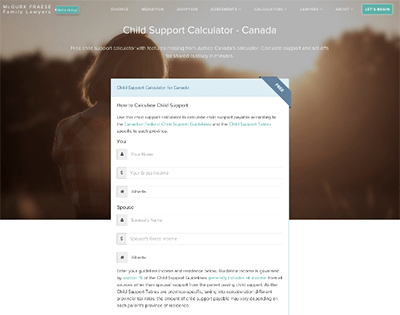
Enter the paying parent's annual gross income before tax, province or territory of residence, and number of children. The calculator returns the monthly Schedule I table amount from the 2025 Federal Child Support Tables, effective October 1, 2025.
The table amount is a starting point. The correct support amount depends on the law that applies, reliable income information, the parenting arrangement, and the facts of the family.
How the table produces the amount
The Federal Child Support Tables match three facts: the paying parent's province or territory of residence, annual income for child support purposes, and number of children. The 2025 tables took effect on October 1, 2025. An earlier support period may require the table in force during that period.
For example, the 2025 Alberta table amount for one child and annual income of $80,000 is $685 per month. That figure answers the base-table question. The next step is to check whether the income figure, parenting arrangement, special expenses, and any existing order or agreement call for further work.
Use the paying parent's table
In a majority-parenting-time arrangement, the applicable table is generally the table for the province or territory where the paying parent lives. The children's residence may be elsewhere. If the paying parent moves from Ontario to Alberta, for example, the Alberta table generally supplies the base amount from the effective date of the change.
Split parenting uses a table calculation for each parent and the children who live primarily with the other parent. Shared parenting starts with each parent's table amount and then considers the increased costs of shared parenting and the condition, means, needs, and circumstances of each parent and child.
Start with the documents, then choose the income figure
Line 15000 of the most recent tax return is often the starting point. A useful income review usually includes the last three income tax returns and notices of assessment or reassessment, together with current proof of earnings. Pay statements, an employer letter, corporate financial statements, partnership records, trust documents, or benefit statements may be required by the circumstances.
The Guidelines contain adjustments for items such as spousal support and certain dividends, capital gains, business expenses, and partnership or corporate income. A three-year pattern may provide a fairer figure where income fluctuates. A one-time bonus or unusual gain deserves separate attention rather than automatic treatment as ordinary annual income.
Section 19 permits a court to impute income in specified circumstances. Examples include intentional underemployment, tax-exempt income, diverted income, unreasonable expense deductions, and incomplete financial disclosure. The practical question is the income available for support under the Guidelines, supported by reliable documents.
When both incomes enter the calculation
Both parents' incomes become relevant in shared or split parenting arrangements, for section 7 special or extraordinary expenses, and in an undue hardship claim. Shared parenting under section 9 generally means each parent exercises at least 40% of parenting time over a year. The analysis considers both table amounts, the increased costs of shared parenting, and the circumstances of each parent and child.
Section 7 expenses can include qualifying childcare, health-related expenses, education, post-secondary costs, and extracurricular expenses. The analysis asks whether the expense fits the Guidelines, whether it is reasonable and necessary in the family's circumstances, what contribution or subsidy reduces the cost, and how the remaining amount should be shared in proportion to income.
For income above $150,000, the Guidelines calculate the table amount on the first $150,000 and add an amount for the balance. One approach applies the percentage shown in the table. Another considers the child's condition, means, needs, and circumstances together with each parent's financial ability to contribute.
A new calculation and an existing order serve different purposes
A current table result can reveal that support may need attention after an income change, a move, or a change in parenting. The existing order or filed agreement remains the enforceable amount until the parties complete the applicable recalculation, agreement, or court process.
Retroactive support and arrears require their own analysis. Current income disclosure, the history of earlier disclosure, notice of a requested change, reasons for delay, the conduct of the parties, and the circumstances of the child can all matter. Keep the documents and dates that explain when income changed and when updated information was exchanged.
When the calculation needs more information
The table result answers one question: the monthly Schedule I amount for the three inputs entered. A fuller support calculation brings in:
- shared parenting time or split parenting arrangements
- section 7 special or extraordinary expenses
- undue hardship claims
- income that is disputed, imputed, self-employment income, or income that varies
- income above $150,000
- retroactive support or arrears
- any order, agreement, variation, or enforcement decision
Use the estimate as a starting figure. The enforceable amount comes from the applicable order or agreement, interpreted alongside the Guidelines and the evidence for the family.
Official sources and services
- 2025 Federal Child Support Tables (Department of Justice Canada, verified August 2, 2026)
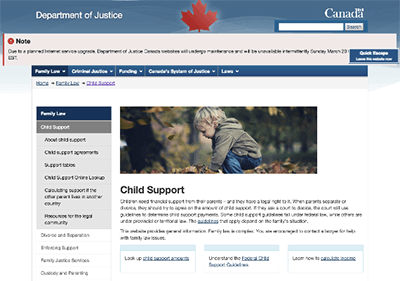
- Child Support Table Look-up (Department of Justice Canada, verified August 2, 2026)
- Federal Child Support Guidelines (Justice Laws Website, verified August 2, 2026)
- Step 5 - Calculate annual income (Department of Justice Canada, verified August 2, 2026)
- Step 6 - Find the table amount (Department of Justice Canada, verified August 2, 2026)
- Colucci v. Colucci, 2021 SCC 24 (Supreme Court of Canada, verified August 2, 2026)